







Numbers shape how we understand the world. And when it comes to one of the most frequently asked demographic questions — What Percentage of the World Is Black — the answer involves far more than a single figure. It involves the fastest-growing continent on earth, a diaspora spread across six inhabited continents, and a population trajectory that will define global demographics for the rest of this century.
What Percentage of the World Is Black?
Roughly 17.9% of the world’s 8.1 billion people are Black or of African descent. That translates to approximately 1.4 billion individuals as of 2024.
The bulk of this population — around 1.2 billion people — lives in Sub-Saharan Africa, which alone accounts for 14.7% of humanity. Outside the continent, an estimated 250 million people of African descent live across the Americas, Europe, the Caribbean, and other parts of the world.
Where Black Populations Live
| Region | Population | Global Share | Annual Growth |
|---|---|---|---|
| Sub-Saharan Africa | 1.202 billion | 84.3% | 2.4% |
| Americas (diaspora) | 142 million | 10.0% | 0.8% |
| Caribbean | 34 million | 2.4% | 0.4% |
| Europe (diaspora) | 18 million | 1.3% | 1.2% |
| Other regions | 29 million | 2.0% | 1.5% |
Within Sub-Saharan Africa, East Africa is the most populated subregion with 492 million people, growing at 2.7% per year. West Africa follows at 435 million. Central Africa holds 203 million, and Southern Africa — the slowest-growing subregion at 1.4% annually — has 72 million residents.
Two Decades of Rapid Expansion

In 2000, the global Black population stood near 814 million. Twenty-four years later it reached 1.4 billion — a 72% rise. The world’s overall population grew 33% over the same window, meaning Africa’s demographic expansion ran at more than twice the global pace.
The continent added 588 million people between 2000 and 2024. To put that in perspective, that single figure exceeds the current combined population of every country in the European Union.
Year-by-year the pace has actually accelerated:
- 2000–2010: Africa gained roughly 23.4 million people annually
- 2010–2020: That annual figure climbed to 27.8 million
- 2020–2024: Despite the COVID-19 pandemic, growth held near 29 million per year
Africa’s share of global population moved from 13.4% in 2000 to 17.9% today — a shift that has reshuffled long-standing assumptions about where population weight sits in the world.
The Age Factor: Why Growth Has Momentum
Demographics is partly about how many people exist now and partly about the age structure that determines how many will exist soon. Africa’s age structure is unlike anything seen on any other continent.
The median age across Africa in 2024 was 19.7 years. The global median was 30.5 years. European and Asian countries frequently exceed 40 years. Nigeria’s median age was 18.6 years. Ethiopia’s was 19.8 years.
| Age Group | Africa | Global Average |
|---|---|---|
| Under 15 | 43% | 25% |
| 15–24 | 19% | 15% |
| 25–54 | 30% | 41% |
| 55–64 | 5% | 9% |
| 65 and older | 3% | 10% |
Nearly two-thirds of Africa’s population is under 25. Even if fertility rates were to decline significantly tomorrow, the sheer volume of people currently approaching childbearing age means population growth will continue at pace for decades.
The growth trajectory is already locked in by the existing age structure, independent of what policy interventions or behavioral shifts might occur in the near term.
The Five Largest Black-Majority Nations
Five countries together account for 41% of Africa’s entire population:
Nigeria tops the list at 223 million people — the sixth most populous country on earth and the largest Black-majority nation by a considerable margin. The country’s median age of 18.6 years suggests it has an enormous amount of demographic expansion still ahead.
Ethiopia holds 126 million residents, making it the second most populous nation on the continent.
Democratic Republic of Congo recorded 102 million people in 2024 and contains some of Africa’s fastest-growing urban centers.
Tanzania reached 67 million, while South Africa — the most economically developed of the five — recorded 60 million.
Population density across the continent swings dramatically. Rwanda sits at 525 people per square kilometer. Nigeria averages 246. Island nation Mauritius reaches 626. At the opposite extreme, Botswana and Namibia fall below 5 people per square kilometer — figures shaped almost entirely by desert geography.
The Diaspora in Detail
The Americas
Brazil carries the largest Black population outside Africa. In the 2022 national census, 120 million Brazilians identified as Black or of mixed African descent — 56% of the country’s total population. That single figure exceeds the population of most African nations individually.
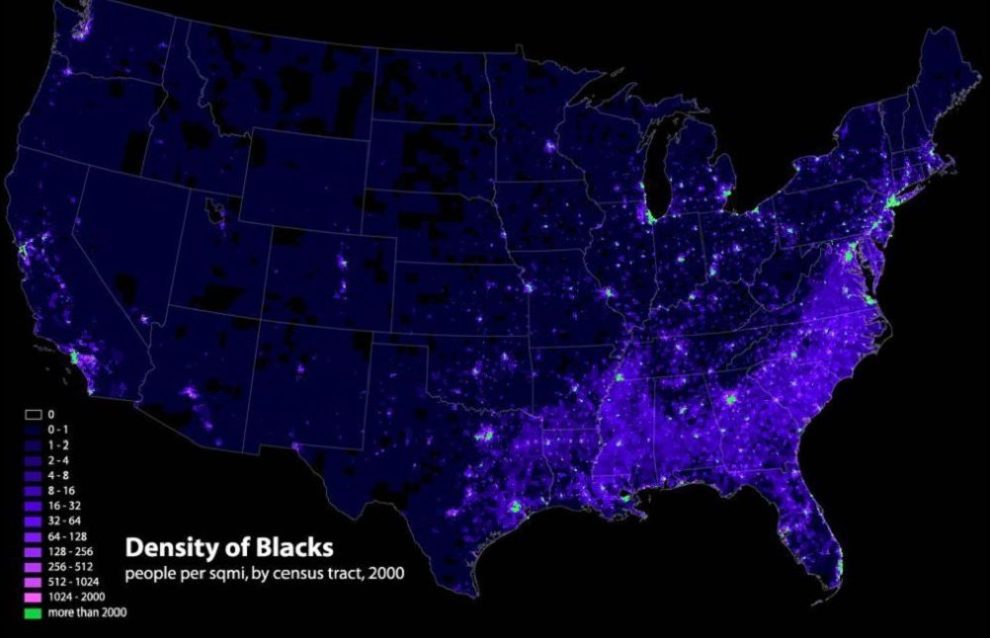
The United States follows, with 47.9 million Black or African American residents counted in 2023 — 14.4% of the national population and 10.8% more than the 2010 count.
| Country | Black Population | National Share |
|---|---|---|
| Brazil | 120 million | 56% |
| United States | 47.9 million | 14.4% |
| Haiti | 11.4 million | 95% |
| Colombia | 5.2 million | 10.6% |
| Jamaica | 2.8 million | 92% |
Europe
France has an estimated 5 to 6 million Black residents as of 2024, though French law prohibits official racial classification in government data, so the figure carries more uncertainty than in countries with formal census categories. The United Kingdom’s 2021 census recorded 2.4 million Black residents — 4% of the population.
Germany reached approximately 1 million, and Italy around 800,000. Growth across European Black populations between 2000 and 2024 was driven primarily by immigration from Sub-Saharan Africa and the Caribbean.
Cities: Africa Crosses a Historic Line
For the first time in recorded history, more Africans live in urban areas than rural ones. Africa’s urban population hit 608 million in 2024 — 50.6% of the continental total — crossing a threshold that Europe crossed in the early twentieth century and Asia only recently passed.
The growth rates of Africa’s largest cities reflect this transformation:
| City | Population | Country | Annual Growth |
|---|---|---|---|
| Lagos | 15.4 million | Nigeria | 3.2% |
| Kinshasa | 15.1 million | DR Congo | 4.1% |
| Luanda | 8.9 million | Angola | 3.9% |
| Johannesburg | 6.2 million | South Africa | 1.8% |
| Nairobi | 5.1 million | Kenya | 3.5% |
Kinshasa’s 4.1% annual growth is among the highest for any major city globally. At that rate, the city’s population doubles in roughly 17 years.
What the Projections Say About the Rest of This Century
The United Nations estimates Africa will hold 2.5 billion people by 2050 — 25.6% of the projected global population at that point, up from 17.9% today. Looking further ahead, the projection for 2100 puts Africa at 4.3 billion people — 39% of a projected world total of 11 billion.
Nigeria’s individual trajectory within that picture is remarkable. Projections place Nigeria at 733 million people by 2100 — potentially surpassing China’s projected population at that point and making it one of the two or three most populous nations on earth.
Growth will not be evenly distributed within Africa. East Africa carries the most aggressive projection, with its population potentially tripling from 492 million today to 1.5 billion by 2100. West Africa could reach 1.2 billion from a current base of 435 million.
Southern Africa, where fertility rates have already begun declining, is expected to grow more gradually — from 72 million today to roughly 140 million by century’s end.
FAQs
What Percentage of the World Is Black?
Approximately 17.9% as of 2024, equivalent to around 1.4 billion people in a world of 8.1 billion.
Which country has the largest Black population in the world?
Nigeria, with 223 million people.
How fast is Africa’s population growing?
At roughly 2.4% per year between 2020 and 2024 adding approximately 29 million people annually during that window.
What is the Black population of the United States?
47.9 million people identified as Black or African American in 2023, accounting for 14.4% of the national population.
Why is Africa’s population growing so quickly?
High birth rates combined with improving life expectancy create growth that compounds over time.
Will Africa become the world’s most populous continent?
Projections suggest it could. By 2100, UN estimates place Africa at 4.3 billion people which would make it the most populous continent, surpassing Asia.
How large is the African diaspora outside the continent?
Approximately 250 million people, concentrated primarily in the Americas (142 million), the Caribbean (34 million), Europe (18 million), and other regions (29 million).
When did Africa urbanize past the 50% threshold?
In 2024, when the continent’s urban population crossed 608 million marking the first time more Africans lived in cities than in rural areas.


