








Webpayblog com is a fintech resource covering the mechanics of digital payments — how money moves online, how transactions are secured, and how businesses and consumers can make better decisions in an increasingly cashless financial environment.
The real questions now are how secure these systems actually are, what the trade-offs look like between different payment methods, and how the landscape continues shifting as new infrastructure matures.
Webpayblog com exists to answer these questions without requiring its readers to have a background in financial technology.
Why Is Webpayblog com Necessary?
Most people who tap a card or complete an online purchase have a reasonable intuition that something secure is happening — but few understand the specific mechanisms involved.
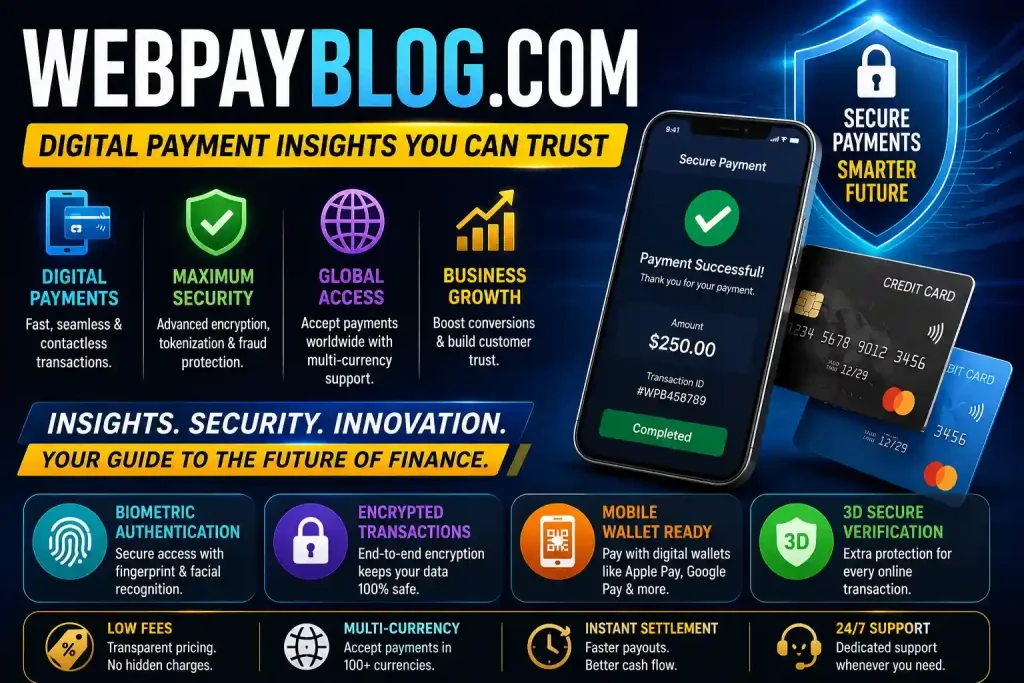
Three mechanisms form the backbone of modern payment security. The first is tokenisation: the replacement of a card number with a one-time-use identifier that has no value outside the specific transaction it was generated for. A merchant that processes a tokenised payment never handles your actual card credentials. If their systems are breached, the attacker finds tokens that are already worthless.
The second is biometric authentication, which has displaced the password as the primary human verification layer in mobile payments. Fingerprint and facial recognition are not just more convenient than passwords — they are structurally harder to steal, because the credential is attached to a physical characteristic rather than a stored string of characters that exists somewhere in a database.
The third is end-to-end encryption, which ensures that payment data is unreadable to any party intercepting it in transit.
Where the Risks Actually Live
Understanding what is secure does not mean understanding what is safe. The largest vulnerabilities in digital payments are not in the payment technology itself — they are in the decisions businesses and consumers make around it.
For consumers, the most common risk is not a sophisticated technical breach. It is paying on a platform that has not properly implemented the protections that exist. A merchant processing card data without PCI DSS compliance, storing card numbers they have no legitimate reason to store, or using a payment page that is not properly encrypted creates an exposure that no amount of good behaviour from the cardholder can fully protect against.
For businesses, the risks centre on dispute management and fraud prevention. Chargebacks — the process by which card issuers reverse transactions at a customer’s request — are the financial mechanism most consistently underestimated by merchants entering the digital payments space.
A business with a chargeback rate above a processor’s threshold faces account suspension regardless of whether the disputes are legitimate. Managing this requires clear product descriptions, visible refund policies, accurate billing descriptors on bank statements, and prompt customer service responses — none of which are payment technology questions, but all of which are payment business questions.
The Payment Gateway Decision
For any business operating online, the choice of payment processor shapes the customer experience, the dispute management process, and the economics of every transaction. The comparison that matters most is rarely the headline transaction rate — it is the total cost and operational fit across the full payment lifecycle.
| Dimension | Traditional Banking Infrastructure | Fintech Payment Gateways |
|---|---|---|
| Time to activate | Multi-week with documentation | Same-day to 48 hours |
| Fee transparency | Often bundled with unclear components | Line-item pricing, typically |
| International payment support | Region-limited in most cases | Multi-currency by design |
| Developer integration | Complex, often requires custom builds | REST API, comprehensive documentation |
| High-volume transaction handling | Reliable but often rigid | Scalable with clear rate tiers |
| Dispute management tools | Manual processes, slow resolution | Dashboard-driven, faster cycles |
The case for traditional banking infrastructure is strongest for businesses with long-established relationships, predictable domestic transaction profiles, and no immediate need for cross-border functionality. For businesses building internationally, scaling quickly, or operating in markets where local payment methods differ from card networks, fintech gateways typically offer a better operational fit.
The Honest Picture on Blockchain Payments
Blockchain payment infrastructure has been described as transformative for long enough that the gap between prediction and adoption deserves direct examination.
In B2B contexts — specifically cross-border transfers between businesses that previously relied on correspondent banking networks — the case is already proven. Removing the intermediary layers from international wire transfers reduces both the cost and the settlement time in ways that are operationally meaningful for companies moving significant volumes.
Stablecoins, pegged to fiat currencies, make this workable without the volatility that made standard cryptocurrency impractical as a commercial exchange medium.
For consumer-facing retail, the infrastructure question is still open. Payment methods succeed with consumers when they are invisible — when they do not require the consumer to understand how they work in order to use them. Blockchain payments have not yet achieved this invisibility for most consumers, which limits their practical adoption regardless of the underlying technology’s merits.
What Good Payment Practice Looks Like in 2026
Start at the checkout and work backwards. The payment page is where purchasing decisions collapse — not because of payment technology failures but because of friction, surprise costs, or missing payment options. Removing mandatory account creation, displaying all costs before the final step, and ensuring the page performs on mobile are the three changes with the largest immediate impact on completion rates.
Treat security as ongoing maintenance rather than a one-time implementation. PCI DSS compliance checked once and then ignored is not compliance — it is a point-in-time snapshot of a requirement that changes.
Diversify payment acceptance deliberately. Relying on a single payment method in any market creates a dependency risk. Customers whose preferred method is unavailable do not usually choose another — they leave. Understanding the payment method preferences of your specific market and ensuring those methods are available is a commercial decision as much as an infrastructure one.
Build chargeback management into operations from the start. The businesses that handle disputes most effectively are those that have clear processes before disputes occur — not those improvising responses after the fact.
FAQs
1. What does Webpayblog com cover?
It is a fintech-focused resource covering digital payment mechanics, payment security, gateway comparison, and practical guidance for businesses and consumers navigating online transactions.
2. What is the most important security practice for online shoppers?
Using payment methods that act as an intermediary — digital wallets, virtual card numbers — so that your core banking credentials are never exposed directly to merchants.
3. How do businesses reduce their chargeback rate?
Through operational clarity: billing descriptors that match the business name, immediate transaction receipts, and responsive customer service that resolves disputes before they escalate to a card issuer dispute.
4. Should small businesses use a fintech gateway or a traditional bank for payment processing?
For most small businesses, fintech gateways offer faster activation, more transparent pricing, better international payment support, and more accessible dispute management tools.
5. When does cryptocurrency become a practical payment option for retailers?
When it achieves the invisibility of mature payment methods — when consumers can use it without understanding it.
6. What is the most overlooked aspect of digital payment strategy?
Mobile checkout performance.