




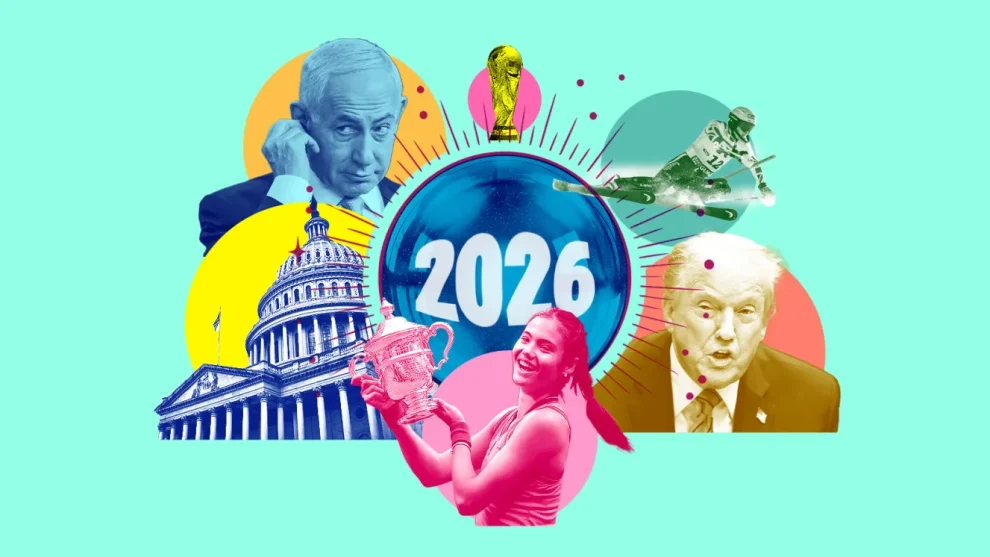

What will happen in 2026? Every January arrives carrying promises nobody can fully keep. But asking the right people what to watch for produces something more useful than optimism or pessimism. It produces specificity.
Experts looked at six different corners of the world and described what 2026 will likely demand of us. The picture that emerges is not uniformly dark, but it is not comfortable either.
What Will Happen in 2026 For Economy
Clement Bohr expects the economy to start the year sluggishly before picking up. Fiscal and monetary stimulus — particularly the effects of the Big Beautiful Bill working through the system — should drive improvement as months pass. His overall read is cautiously optimistic, with one condition attached: policy needs to stay stable and predictable.
What Bohr is watching more carefully than any single economic indicator is the concentration of AI-driven wealth. Seven companies currently account for roughly a third of all Wall Street value. The question of whether this constitutes a bubble has a nuanced answer in his view — these corporations hold enough cash reserves to absorb downturns and sustain infrastructure investment through 2026 even if markets become turbulent.
The longer-term math, however, is more demanding. AI-related revenue across these companies currently runs around $60 billion annually. By 2030, Bohr estimates that figure will need to reach somewhere between half a trillion and a trillion dollars just to justify the chip infrastructure and operational costs being built today. Whether that gap closes or gapes is a question 2026 will begin answering.
Technology: The Adolescent Problem
Ramesh Srinivasan frames AI’s current moment with an image worth holding: it has graduated from loud infant to hungry teenager. The phase has a name he uses — “technolescence” — and it carries the same unpredictability that adolescence usually does.
The resource demands are concrete and growing. Land, water, and electricity consumption by AI infrastructure are measurable and already significant.
The social costs are harder to quantify but no less real: effects on labor markets, on how people form beliefs, on what counts as authoritative information in a world where synthetic content is indistinguishable from documented fact. Whether governments are positioned to regulate the dark edges of this expansion, Srinivasan says, is something 2026 will start revealing.
Public Health: The Misinformation Burden
Robert Kim-Farley identifies three overlapping threats to public health in 2026: misinformation, disinformation, and what he calls “malinformation” — false or misleading information spread deliberately for political advantage or out of calculated malice.
The return of measles to American communities — a disease that had been functionally eradicated — is the signal he points to most forcefully. It did not come back because vaccines stopped working. It came back because vaccine confidence eroded. Debunked connections between vaccines and autism, amplified by people he describes as occupying positions of influence, have produced real and measurable harm. That dynamic is not receding in 2026.
On the structural side, rising healthcare costs — driven in significant part by reduced support for the Affordable Care Act — are forcing a conversation that Kim-Farley thinks is overdue: how healthcare in the United States is actually paid for, and by whom, and on what basis.
Climate: A Year of Reckoning
Glen MacDonald is not optimistic about 2026 on climate. He is precise.
Public interest in climate change fell significantly in 2025. The COP30 conference in Brazil saw meaningful no-show numbers among nations that had previously committed to environmental targets. The research infrastructure tracking long-term environmental change, including the high-altitude monitoring work MacDonald’s center conducts, faces funding pressure that threatens continuity of data that has taken decades to accumulate.
The 1.5 degrees Celsius threshold — a benchmark that climate scientists have long treated as a critical marker — may be tested in 2026. MacDonald stops short of saying it will definitely be crossed, but says the world is very close, and that 2026 is most likely to be warmer than 2025.
For California specifically, the arithmetic of rainfall is stark: the state depends on roughly twelve significant rainstorms per year. Lose two or three and drought conditions return. The state’s water security has narrower margins than most residents understand.
Law: The Court as Political Instrument
Joseph Fishkin, constitutional scholar at the UCLA School of Law, describes the current Supreme Court as the most conservative since the late nineteenth century. What concerns him specifically about 2026 is not just the Court’s ideology but its relationship to democratic accountability.
Two questions Fishkin treats as genuinely open — not rhetorical — are whether birthright citizenship under the 14th Amendment will remain as interpreted for over a century, and how far the Court will narrow the Voting Rights Act while maintaining an appearance of moderation.
His prediction: the Court will likely decline the most extreme challenges, wanting to avoid the appearance of raw political action, but will still reshape settled law in ways that benefit White House political allies without triggering the kind of backlash that more explicit overreach would produce.
Popular Culture: The Sound Nobody Predicted
Tiffany Naiman makes her living watching trend lines — and she is direct about the limits of trend-spotting. Nobody predicted K-pop Demon Hunters or the 6-7 meme as cultural phenomena. The next organic surprise will almost certainly arrive from a direction that analysts are currently not watching.
What she does see coming has specific shape. Electronic dance music is fading as her students move toward guitars and instruments that create physical, personal connection with audiences. Authenticity is the value driving this shift — a counter-reaction to the saturation of AI-generated content in streaming and social platforms. Underground roots music, Afrobeat, and Latin American sounds are all gaining momentum.
The wave she watches most closely is M-pop: Mandarin-language music originating from China and Chinese-speaking markets. Artists including Jay Chou, G.E.M., Jolin Tsai, and Singaporean artist Stefanie Sun are in active preparation for the American market.
FAQs
What is the biggest economic risk for 2026?
Loss of Federal Reserve independence through a Supreme Court ruling that could allow presidential removal of Fed board members.
Why is measles returning relevant to 2026 public health concerns?
It demonstrates that vaccine hesitancy driven by misinformation has already produced real public health consequences.
What is the 1.5°C threshold and why does it matter?
A temperature rise limit that climate scientists have identified as a critical boundary above which certain climate effects become significantly harder to reverse.
What Supreme Court cases concern most for 2026?
Cases touching on birthright citizenship under the 14th Amendment, the scope of the Voting Rights Act, and — overlapping with economic concerns.


