






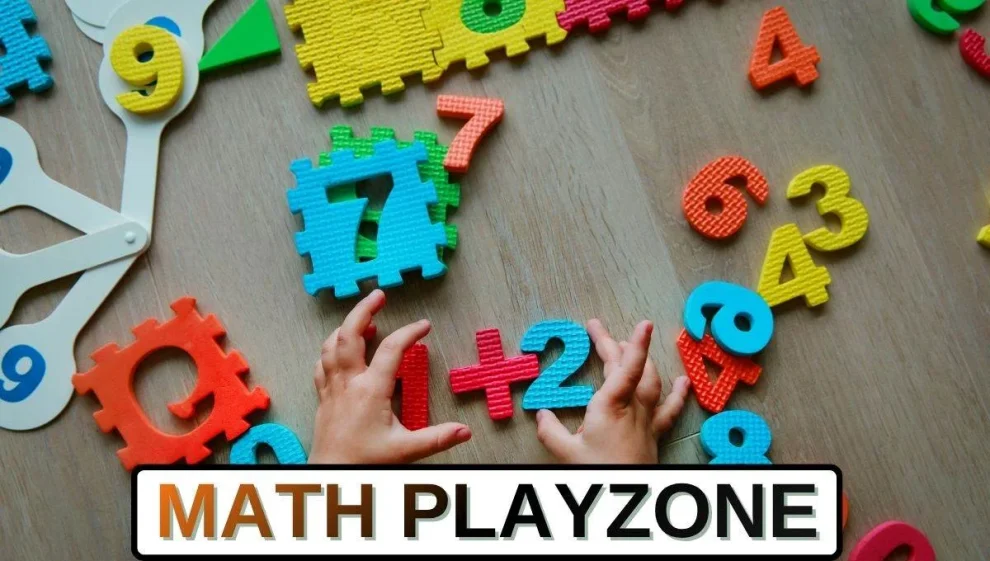

Here is something that does not happen often: a child finishing dinner and asking to do math.
MathPlayzone makes that happen. Not because it tricks children into learning, but because the games are good enough that the math inside them stops feeling like the point. The numbers become the mechanism. The game becomes the reason.
MathPlayzone: The Basic Idea
MathPlayzone is a free browser-based platform for children from kindergarten through sixth grade. No downloads. No account required to start playing. A child can be mid-game within thirty seconds of the page loading.
The subject range covers what K-6 demands: addition, subtraction, fractions, geometry, and logical reasoning. Stages grow harder as a child advances, so there is always something slightly beyond what they have already mastered — the kind of calibrated challenge that keeps attention engaged rather than sliding into boredom or frustration.
Adults — parents and teachers both — get a data layer running underneath the games. Every attempt is timestamped. Accuracy is recorded per topic. Subject-area breakdowns appear automatically. Nobody has to track anything manually.
Five Games Children Actually Return To
Not every game on every educational platform gets replayed willingly. These five earn repeat visits:
Number Ninja demands fast thinking. Players chop digits to reach a target number against the clock. The urgency is real enough that calculation speed improves without anyone announcing that is the goal.
Make 10 Course sends a character through an obstacle course steered by forming sums of ten. The movement metaphor does something interesting — it makes number bonds feel physical rather than abstract.
Shape Tetris asks players to rotate geometric pieces into spaces. Children who struggle with written geometry questions often find spatial reasoning clicks faster when it lives inside a puzzle game.
Word Pizza builds fraction understanding by assembling pizza slices into complete pies. Part-whole reasoning, typically a sticking point in late elementary school, becomes something children request rather than resist.
Logic Machine presents step-based puzzles that require working through a sequence to reach a solution. Unlike recall-based exercises, this one develops the kind of structured thinking that transfers across every subject.
What the Data Actually Shows Adults
The platform tracks four things that manual monitoring cannot match:
| What Gets Tracked | Why It Matters |
|---|---|
| Accuracy per stage | Shows which specific concepts need revisiting |
| Timestamps on attempts | Reveals pace and where children slow down |
| Topic-area breakdown | Separates strong areas from weak ones automatically |
| Badge and achievement records | Documents progress over time without paper logs |
A teacher reviewing this data before a Monday lesson can see that most of the class sailed through addition but stalled on regrouping. That is a lesson-planning insight, not just a performance report. A parent seeing the same pattern at home knows exactly where twenty minutes of focused practice will do the most good.
The Confidence Problem Math Creates Early
Children who decide they are “not math people” often make that decision before age ten. It rarely comes from a single bad test. It builds from accumulated small moments where numbers felt unpredictable — where trying hard did not seem to produce improvement.
MathPlayzone disrupts that pattern in a specific way. Because children are playing games rather than sitting a test, effort does not feel exposed in the same way. A wrong answer means trying the level again, which is what you do in games.
The emotional weight attached to mathematical error is lower, and lower emotional weight means children stay in the discomfort of not-yet-knowing long enough to push through to understanding.
That shift in relationship with difficulty is worth more than any single skill the platform teaches.
Practical Habits That Amplify MathPlayzone
Daily practice over a month outperforms occasional long sessions. Fifteen minutes after school five days a week beats ninety minutes on a Sunday. Frequency matters more than volume for retention.
Connecting what happens on screen to real-world situations deepens the learning. A child who just played Word Pizza and then helps measure flour for a recipe is doing the same fraction reasoning in two different registers. That cross-context repetition cements understanding faster than either activity alone.
Letting two children compete on the same stage — siblings, classmates, even a parent deliberately playing slightly below their ability — introduces social motivation that is hard to manufacture any other way. Children who would not push for a higher personal score will absolutely push to beat someone sitting next to them.
After a session, one question tends to be more useful than any formal review: “Which one felt impossible at first and then clicked?” That question asks children to identify their own learning moments, which builds the metacognitive awareness that separates students who know how to learn from those who only know how to follow instructions.
For Classrooms Specifically
The no-account requirement matters more than it might appear. In schools where device time is limited and IT processes are slow, a platform that requires student registration, email verification, and teacher setup before a single game can be played often goes unused. MathPlayzone removes all of that. The barrier between “we should use this” and “we are using this” is effectively zero.
The dashboard gives teachers classroom-wide visibility without creating additional administrative work. Subject-area patterns become visible across a whole cohort — information that typically only surfaces during formal assessment, by which point it is too late to adjust instruction before the unit ends.
For schools already running other digital tools, Math Playzone’s self-paced model fills a specific gap. Live competition platforms generate excitement but can leave slower learners behind. Math Playzone lets every child work at the level where genuine learning is happening, without the social comparison that faster-paced formats create.
FAQs
What exactly is MathPlayzone?
A free online platform turning K-6 arithmetic into games, covering addition, subtraction, fractions, geometry, and logical reasoning.
Does MathPlayzone cost anything?
No. Core games are freely accessible without payment or registration.
Do children need to create an account?
No. Students can begin playing immediately without any signup process.
What ages is MathPlayzone designed for?
Roughly ages 5 to 12 — kindergarten through sixth grade — with difficulty scaling to match each level.
How do teachers access progress data?
Through a classroom dashboard showing accuracy rates, attempt timestamps, and topic-area breakdowns for each student.
How is MathPlayzone different from other math game platforms?
It combines genuinely replayable games with meaningful performance data. Many platforms do one or the other well.
What is the ideal daily practice time?
Fifteen minutes daily produces better results than longer infrequent sessions. Consistency matters more than duration.
Can MathPlayzone be used alongside school curriculum?
Yes. Parents can assign practice tied to current classroom topics. Teachers can integrate it as a warm-up, rotation station, or take-home tool without disrupting existing lesson structures.
