






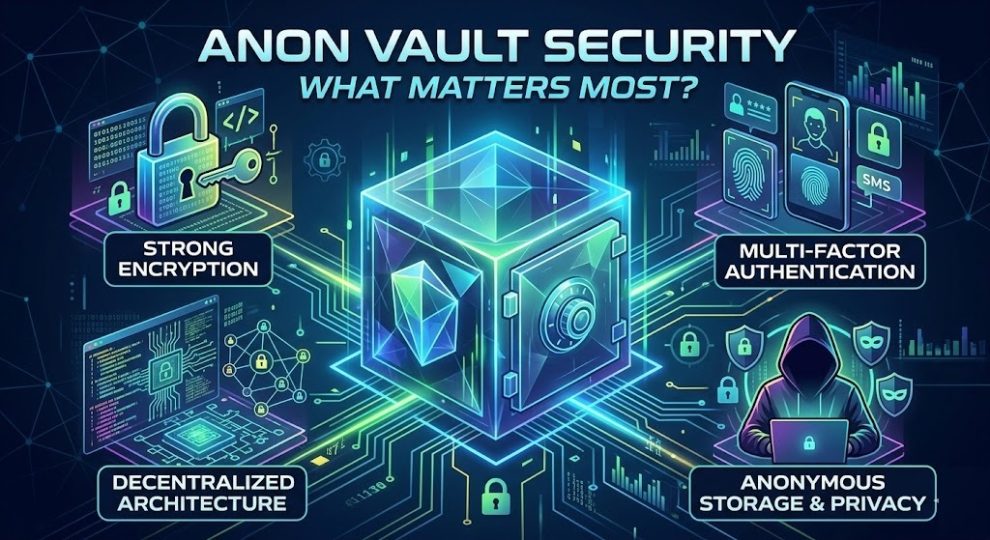

Start with the uncomfortable question most cloud users never ask: who else can technically open your files right now? Anon Vault exists to make that answer “nobody, structurally impossible,” and the mechanics behind that claim are worth walking through carefully.
Anon Vault: The Trust Problem, Stated Plainly
Conventional cloud storage works like this: you upload a file, the provider stores it, and the provider also holds the keys needed to decrypt and view it. That’s not a hypothetical risk — it’s the literal architecture. An employee with database access, a court order compelling disclosure, a breach exposing both the data and the decryption capability simultaneously — all of these scenarios exist because storage and access live in the same hands.
Anon Vault breaks that pairing apart on purpose.
Encryption That Happens Before Upload, Not After
The scrambling occurs on your device, before a single byte travels anywhere. AES-256 — military-grade encryption — locks the file locally. What leaves your machine is already unreadable nonsense to anyone without your specific key.
This timing detail matters more than it sounds. Plenty of services encrypt data “in transit” or “at rest” on their servers — but if they’re the ones performing that encryption, they necessarily hold the key too. Anon Vault’s model removes that step from their side entirely. The file arrives pre-locked, and Anon Vault never possesses what’s needed to open it.
A breach of their infrastructure, then, nets an attacker nothing but cryptographic static.
Spreading the Risk: How Storage Gets Distributed
Centralized storage has one obvious weakness: compromise the center, compromise everything. Anon Vault avoids this by splitting data across multiple servers rather than parking it in a single location.
Picture distributing valuables across ten different safety deposit boxes instead of one. Even total compromise of one location leaves the rest intact. Organizations get to choose how this plays out — fully cloud-hosted, fully on-premises, or some mix of both — managed through a single console regardless of the underlying split.
It’s available through established enterprise channels too: IBM Cloud Catalog and the RedHat OpenShift Marketplace, which at minimum signals it’s passed some baseline vetting to land in those listings.
The Concept That Ties It Together: Zero-Knowledge

Here’s the distinction that separates Anon Vault from “we encrypt your stuff” marketing claims generally: zero-knowledge means the provider itself never has access to your unencrypted content — not occasionally, not under special circumstances, not ever.
Compare it to a safety deposit box at a bank. The institution knows the box exists and that it belongs to you. They cannot open it. They cannot tell anyone what’s inside, because they genuinely don’t know. Anon Vault applies this exact principle to digital storage — the platform confirms your account exists without ever seeing what that account contains.
The compliance upside here is substantial. GDPR and CCPA exist largely to govern who can access personal data and under what justification. When the storage provider architecturally cannot access that data themselves, an entire category of regulatory exposure disappears — not because of a policy commitment, but because of how the system is built.
What This Buys You, Practically
You’re not trusting a privacy policy. Standard platforms ask you to believe they won’t look at your files. Anon Vault makes looking technically impossible. That’s a meaningfully different guarantee.
Breaches become low-value events. Attackers who successfully breach the infrastructure walk away with encrypted data they cannot use, because the keys were never stored alongside it.
Threat monitoring without content inspection. The system can flag unusual access patterns and alert you in real time — without ever needing to look inside your files to do it.
Fine-grained permission control. Admins can define exactly who can view, manage, or rotate encryption keys, independent of who has general storage access.
Multi-device sync without exposure. iOS, Android, and desktop clients all stay synced, and the contents remain encrypted throughout that entire sync process.
Getting Set Up Without Breaking the Model
The setup sequence is simple, but one step is genuinely non-negotiable:
- Find Anon Vault through IBM Cloud Catalog or RedHat OpenShift Marketplace
- Decide on deployment — cloud, on-premises, or hybrid
- Pull the relevant client library from GitHub for your stack
- Generate encryption keys and store them somewhere completely separate from your data
- Run a test upload before trusting it with anything important
- Turn on multi-factor authentication
- Link your devices to the vault
Step four is the one people skim past and shouldn’t. If your keys end up stored next to your data — same drive, same backup, same anything — you’ve quietly rebuilt the exact vulnerability zero-knowledge architecture is designed to eliminate. The whole point collapses if convenience wins that argument.
Treating Keys Like the Actual Asset They Are
There’s no “forgot password” recovery flow here in the traditional sense — no central authority holds a master key to bail you out. That’s the tradeoff for genuine zero-knowledge privacy, and it changes how seriously key management needs to be taken.
Worth doing without exception:
- Rotate keys on a schedule, not just when you suspect a problem
- Restrict who can access keys to the smallest necessary group
- Never send a key through email, Slack, or any chat platform — these were never built as secure transport
- Keep a backup key stored physically separate from your primary data
- Periodically test that your recovery process actually works before you’re forced to rely on it under pressure
- Log and review key access regularly — who touched it, when, from where
The Real Difference, Summarized
It’s not that Anon Vault is “more secure” than typical cloud storage in some vague marketing sense. It’s that the provider literally cannot see your data, by design, rather than by promise. That’s the entire distinction, and it’s the reason zero-knowledge architecture keeps getting adopted by anyone who’s thought seriously about what “trust” actually means when a third party is holding your files.
FAQs
Does Anon Vault work with Tor or Android?
Yes, both are supported for additional access-layer security.
What happens to my data if Anon Vault’s servers are breached?
Attackers get encrypted data only — the keys needed to read it never live on the same infrastructure.
Is there any relation to the Fallout game series?
No, purely coincidental naming — this is encrypted cloud storage, unrelated to game lore.
What encryption standard is used?
AES-256, the same standard used in military and government-grade security contexts.
What happens if I lose my encryption keys?
Your data becomes permanently inaccessible — there’s no central authority able to recover it, which is the direct tradeoff for true zero-knowledge design.


